
One in 25 Black Americans has the gene for a hereditary disease they may have never even heard about.
Amyloidosis is an underdiagnosed, progressive group of diseases characterized by the abnormal buildup of a protein called amyloid in organs and tissues throughout the body. Jonathan Dotson, founder of the Miami-based organization Friendship that Gives, hosted a community conversation on the illness this past weekend.
The panel discussion, coined “Fashionably Healthy,” took place Saturday at Second Baptist Church in Richmond Heights. It featured information tables as well as an open conversation on how the Black community can do a better job at speaking out about such diseases.
Dotson’s own parents struggled with Parkinson’s disease, a type of amyloidosis that affects the brain. But when his father was diagnosed, he didn’t know what the illness was. Parkinson’s was simply referred to as “the shakes,” despite presenting other serious symptoms.
Jonathan Dotson
A Friendship That Gives founder Jonathan Dotson tells the story of caring for his parents to the attendees.
(Morgan C. Mullings for The Miami Times)
“We don’t talk, we suffer in silence. Your neighbor doesn’t even know what’s going on,” Dotson told The Miami Times.
After his father passed, he asked his mother if she knew how sick his father was. “No. He wouldn’t share. As a Black man, pride is real.”
Dotson’s father, Albert E. Dotson Sr., served on the boards of many Miami institutions, including Baptist Health South Florida. “He had access to all this healthcare, but nobody could tell him what he had,” Dotson said.
A Friendship That Gives is Dotson’s opportunity to “share with underserved communities and overlooked communities about health disparities.” The organization focuses on health and wellness, college readiness and relationships — the foundation for community and the possible solution to the lack of knowledge on amyloidosis.
Before Dotson started the organization, he spent 35 years with 100 Black Men of South Florida, including serving as president.
Saturday’s event featured Dr. Allison Davis of Sunshyne Mynds counseling, Parkinson’s Foundation representative Jennifer De Gruccio, Amyloidosis Army Founder Mike Lane, and Licensed Clinical Social Worker Shavone Williams-Moss. They intend to hold an event every quarter year.
Shavone Williams-Moss
Shavone Williams-Moss, licensed clinical social worker and counselor, tells her personal story of mental illness in her family.
(Morgan C. Mullings for The Miami Times)
Creating conversation
As a white man, Lane acknowledged his unexpected presence at the small gathering of Black locals.
“You’re probably saying, ‘What is this old white guy doing in a Black church talking about disparity?’ Nobody’s trying to bring this message to the community,” he said.
Davis and Lane
Dr. Allison Davis and Mike Lane discuss the difficulties of getting treated for physical and mental illnesses, like advocating properly for yourself or a family member.
(Morgan C. Mullings for The Miami Times)
His passion comes from living with amyloidosis and from 10 years of advocating for himself in a medical system that wanted to diagnose him with anything else.
“It was only when my heart got so bad … then I finally found the doctor who knew what it was,” Lane said.
After countless emails and legal documents, he was eventually cleared for a medication not available in the U.S. on compassionate use.
“You have to be your own best advocate. I don’t care if you go to a doctor’s office, it’s your brother-in-law and he’s not charging you. If you have the symptoms for amyloidosis and he doesn’t want to give you the test or doesn’t want to look into it, you need to go to another doctor.”
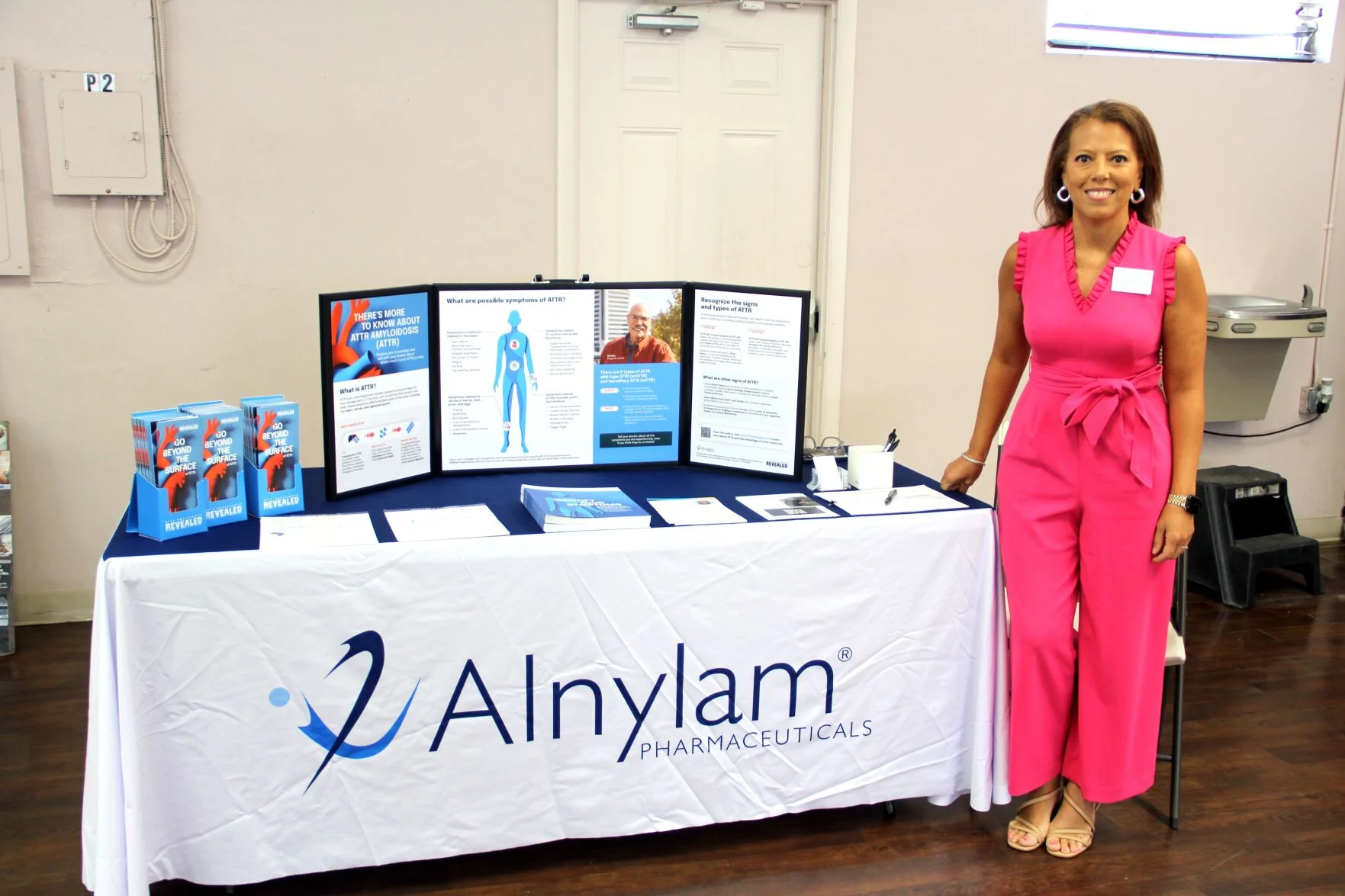
Today, there’s Alnylam Pharmaceuticals, which sent Patient Education liaison and RN Chrissy Currie to provide helpful resources on how patients can get treatment. She is often seen in homes educating families on amyloidosis. As a representative of a pharmaceutical company, she cannot provide any medical advice — only information on what amyloidosis is, how it can worsen over time and how it can affect multiple parts of the body.
The protein transthyretin (TTR) carries vitamin A and other substances throughout the body. When they take on an abnormal shape, they become toxic to the body and build up in various areas. Abnormal TTR or amyloid deposits are what characterize the disease. At ages 50 and above, patients can experience numbing or tingling in their feet, carpal tunnel syndrome, abnormal heart rhythms, digestive issues and a host of other problems that doctors can treat individually, never knowing it was amyloidosis all along.
Chrissy Currie
Chrissy Currie joins the panel conversation to explain how she educates patients in-home about amyloidosis.
(Morgan C. Mullings for The Miami Times)
The hereditary type is what puts Black people at risk.
“The most common is 122I, which is specific to African Americans, Afro-Caribbeans,” she told The Miami Times, “Sometimes it takes one doctor to really pinpoint and connect the dots so that they can get a diagnosis.” Otherwise, she said, they’re going to band-aid the various symptoms. While medication cannot reverse the damage, “It can keep them from progressing and give them a better quality of life.”
Mental, physical and community health
Dotson presented questions to the panel that took the conversation beyond amyloidosis. Gruccio from the Parkinson’s Foundation said Floridians should be having more conversations about the disease, since 80,000 are receiving care for it in the state.
“What about those who are too far from care or they’re not well enough to see someone, or they don’t have insurance?”
The conversation sometimes stops at “the shakes,” but celebrities like Michael J. Fox are raising awareness in a new way.
“You’re seeing that Parkinson’s is so much more than just a tremor. It’s the stooped posture. Maybe it’s the walking that’s a little bit delayed or slower,” Gruccio said. “It’s one of my biggest goals to make sure that we’re representing everyone … more importantly, if you’re Hispanic or Asian or Black.”
Dr. Allison Davis
Dr. Allison Davis shares how mental illness can give way to physical illness if untreated.
(Morgan C. Mullings for The Miami Times)
Two mental health professionals chimed in on health beyond the physical. Williams-Moss’ caregiving story was unique; her mother struggled with bipolar disorder and was homeless her daughter’s whole life. When Williams-Moss took her in, she passed shortly after.
“She had all these other issues that just start coming up, and you know why? Because of access.” She says access to insurance, mental health care and transportation, plus the stigma surrounding discussions of mental health, all limited her.
Williams-Moss spoke of the many ways people can start taking care of themselves, describing journaling as a good place to start, even when you can’t be consistent. She also started a conversation on why diseases like amyloidosis go untested and untreated among Black people.
Chantelle Hall
Chantelle Hall, MDC respiratory program director, explains how tar can build up in the lungs from frequent smoking.
(Morgan C. Mullings for The Miami Times)
“There’s a trust issue. I don’t want to come and be vulnerable to someone that doesn’t even understand my experience from my ethnicity,” Dr. Davis chimed in. The Tuskegee syphilis experiment, for instance, created a legacy of distrust among Black patients.
However, if more Black people don’t get tested and participate in clinical trials, they will continue to suffer from inadequate treatment, Lane said.
“There’s tons of reasons for the Black community not to trust America … but in the same token, if nobody does clinical trials on Black people to treat diseases affecting Black people, they’re not going to get effective treatments.”
Community Health of South Florida
Community Health of South Florida was available at 9 a.m. to screen patients for free.
(Morgan C. Mullings for The Miami Times)
Among the tables sharing information on Parkinson’s and amyloidosis, there was also one on respiratory health, providing a demonstration of smoke-damaged lungs. Chantelle Hall, MDC respiratory program director, discussed how the rising popularity of vaping is much more dangerous than smoking.
“Today is really important and very powerful because we have to get used to trusting each other and wanting to be comfortable to say you need help — mental help or physical help,” Hall said.
Attendees left the event Saturday with pamphlets on the issues discussed. Outside, a Community Health of South Florida bus and tent were waiting with free health screenings, allowing anyone who heard the information indoors to get care.